5,000 Streams = $10: The Math That Changed How We Support Artists
A tangent from the research rabbit hole

Last week I sat down to consolidate our family’s music subscriptions. Four services. Four separate payments. Nobody sharing anything.
The math was embarrassing: Amazon Music Family (that only Wyatt used), my Spotify, two separate Pandora accounts. $475 a year.
What started as a simple “let’s save money” project turned into a research spiral that changed how I think about paying for music entirely.
The Numbers Shocked Me
I was vaguely aware that streaming services didn’t pay artists much. But I’d never actually looked at the numbers.
Here’s what artists earn per stream on major platforms (ordered from lowest to highest paying):
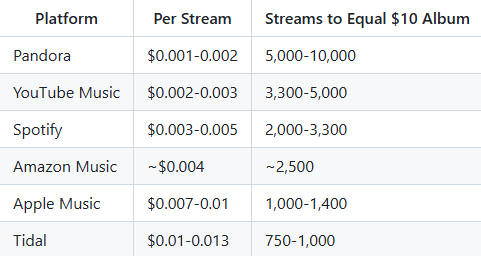
Read that Pandora line again. An artist needs five to ten thousand streams to earn what they’d make from one album sale. We’d been paying $6/month for years to a service that pays artists less than half a penny per play.
One detail doesn’t show up in these averages: free-tier listeners generate dramatically less revenue for artists. On Spotify, 58% of users are on the free tier, but they contribute only 10% of artist revenue. If you’re streaming without a paid subscription, artists are earning even less than these already-tiny numbers suggest.
This isn’t just an indie artist problem. A UK Musicians’ Union survey found that eight out of ten music creators earn less than £200 a year from streaming - while the three major labels report record profits.
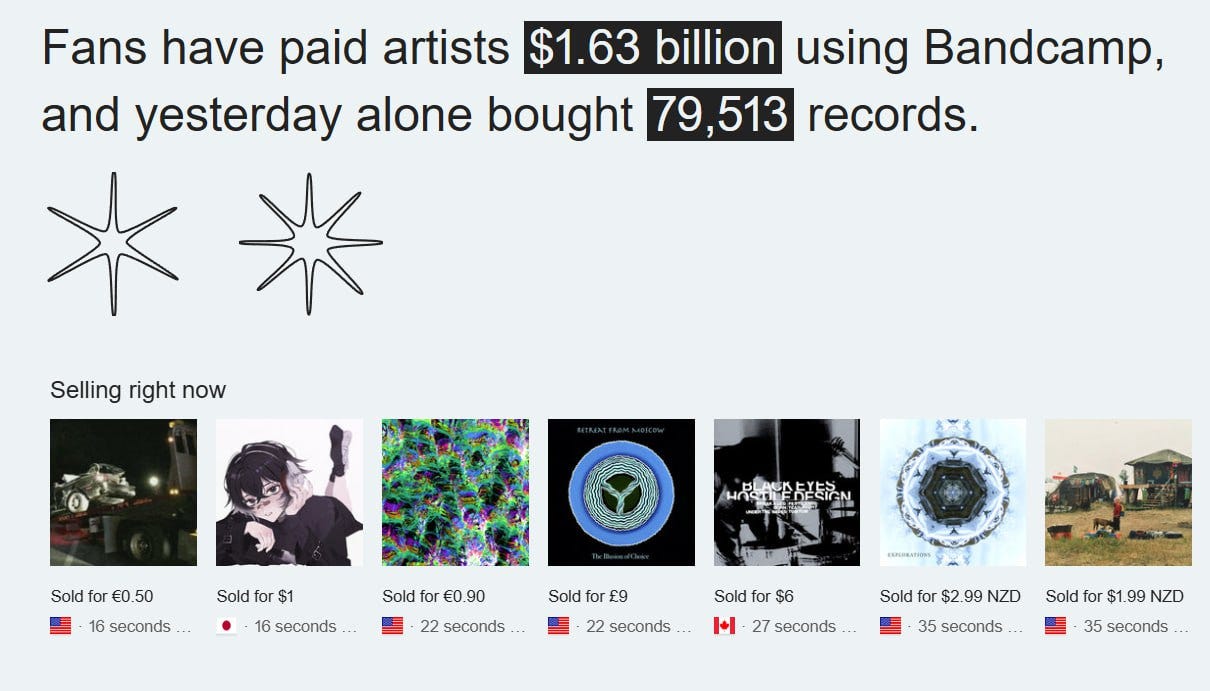
Meanwhile, when you buy an album directly from an artist or through Bandcamp, 80-100% goes to the creator - typically within 48 hours. Bandcamp’s revenue share is 15% on digital, 10% on physical, with payment processing fees on top.
That’s not a rounding error. That’s a completely different economic model that directly supports the artists
When the Math Becomes Personal
The per-stream rates stopped being abstract when I applied them to our actual listening.
If Wyatt listens to an album 100 times on Amazon Music, the artist earns roughly $1.50-2.50. If he buys that album once for $10, the artist gets $8-10 directly.
One purchase equals 300+ streams of artist support.
For music you genuinely love - the albums you return to again and again - buying is the only math that makes sense. Streaming is fine for casual listening, for discovery, for background noise. The moment an artist becomes part of your regular rotation, streaming becomes a terrible deal for them.
The Question Nobody Asks
The usual framing is: Which streaming service should I use?
The better question is: How am I listening to music, and how can I best support the artists whose work I love?
When I asked my family, the answers were different for each of us:
Wyatt (17, heaviest listener): Needs discovery, cares about audio quality, hates YouTube ads with a passion - especially on YouTube Music, which he finds even more annoying than video ads. He was also killing his phone battery listening to videos because free YouTube requires the screen to stay on.
Shane (spouse): Doesn’t explore new music at all. Built his Pandora stations years ago and just wants them to keep playing. Watches maybe two YouTube videos a month for how-to content. Doesn’t care about ads.
Me: Building a high-res library, supporting artists, starting a YouTube channel so my usage is increasing and ads are annoying. I’m adaptable about which service - I care more about the principle than the platform.
Toward the end of our conversation, we all agreed our main goal was making sure creators get compensated for the work we enjoy so much, and owning the things we pay for, rather than renting. We decided to build a library. Streaming is just how we will find what to buy. The library we own is how we’ll actually consume it.
Three people, three completely different needs. And we’d been paying for four services that served none of us, or the artists well.
What Platforms we Decided On
We landed on: YouTube Premium Family + Shane’s Pandora = $336/year
That saves us $139 annually while giving us:
No YouTube ads (Wyatt’s most-hated thing)
Screen-off listening on mobile (no more dead phone batteries)
YouTube Music for discovery - with the largest catalog of any platform
Shane’s Pandora stations untouched
Support for YouTube content creators (not just musicians, but educators, reviewers, and creators we watch regularly)
That last point matters. YouTube Premium revenue goes to the creators whose content we actually watch. It’s a different kind of artist support, but it’s real - and it aligns with how our family actually uses the platform.
The subscription is just the discovery layer now. The real shift is what we do with the savings.
The Purchase Priority
When we find music worth keeping, here’s how we buy:
1. Direct from the artist. Band websites, concert merch tables, artist-run stores. Maximum money to the creator, often with extras like liner notes or bonus tracks.
2. Bandcamp, HDtracks, 7digital, or Qobuz - depending on who has the album and what quality is available. Bandcamp likely gives the largest share to artists when they have an album, but their catalog is indie-focused. For mainstream releases, the other hi-res download stores fill the gap.
3. Used CDs. This has become a family treasure hunt. Thrift stores, used record shops, library sales. A CD that cost $15 new might be $2 used, and we rip it to lossless quality for our library. While our purchase doesn’t directly pay the artist today, someone paid full price originally - the artist did benefit from that first sale. The used ecosystem is ethically different from streaming, where artists get fractions of pennies indefinitely.
Wyatt identified 40+ albums from his current listening that he’d buy if he had the budget. At roughly $12 average, that’s $480 to catch up on music he already knows he loves. Going forward, maybe 4-5 new albums a year.
The subscription savings don’t cover the whole backlog. They shift the economics - and more importantly, they shift the mindset.
Why We Passed on Tidal
Tidal pays artists roughly 3x what Spotify does. It has lossless audio. It was founded by artists specifically to address compensation issues. On paper, it’s the ethical choice.
We seriously considered it. Tidal Family would have been $264/year - even cheaper than YouTube Premium.
But Wyatt made a compelling practical argument: YouTube has a larger catalog than Tidal. If the goal is discovery - finding new music to eventually buy - you want the biggest pool to explore. YouTube also includes live performances, covers, remixes, and deep cuts that don’t exist on traditional streaming platforms.
Combined with his YouTube ad hatred and the battery-killing screen-on requirement, and the fact that our YouTube Premium subscription would benefit YouTube creators too, the decision became clear. We chose YouTube Premium and committed to buying albums - which puts more money in artists’ pockets than any streaming service anyway.
The math: 100 streams on Tidal ≈ $1.30 to artist. One album purchase ≈ $8-10 to artist. Buying beats streaming at any pay rate.
Building Your Own Music Library
One rabbit hole led to another: if we’re buying albums digitally, where do they live?
The answer for our family is a NAS (Network Attached Storage) - essentially a personal server that holds our music library and streams it to any device in the house. Software like Jellyfin or Plex turns it into your own private Spotify, accessible from phones, computers, even car systems.
The setup isn’t trivial, but the payoff is real: music you own, organized how you want, available forever without monthly fees or licensing changes. No algorithm deciding what you should hear. No songs disappearing because a label pulled rights. Your library, your rules.
If you’re curious, search “Jellyfin NAS setup” or “self-hosted music streaming” - there’s a whole community of people building exactly this.
What I’m Taking From This
The research rabbit hole gave me more than a cheaper subscription plan. It gave our family clear guidelines on how to spend in line with our values when it comes to music.
Streaming is for discovery and convenience. It’s the radio of our era - background music, finding new artists, casual listening. Perfectly fine for that purpose.
Ownership is for music that matters. The albums you return to, the artists you want to support, the songs you want to keep forever regardless of which service you’re paying for this year.
The question isn’t “which service pays best.” The question is: How do I actually listen to music, and how can I best support the artists whose work matters to me?
Our $475 mess became a $336 system that actually works for how each of us uses music. More importantly, it became a framework for thinking about where our money goes and who benefits from it.
Sources: Streaming payout rates and free-tier revenue data from Royalty Exchange 2025, The Metalverse, and RouteNote. UK artist income data from The Conversation. Bandcamp revenue share from their Fair Trade Music Policy. For context on how streaming economics are evolving, see The Changing Economics of Music Streaming: 2025.Though a bit older - 2020 - this article from NPR is also worth a read: A Tale of Two Ecosystems: On Bandcamp, Spotify and the Wide-Open Future.